
Yes, Norway is a war profiteer
Apr 23, 2026
The sad reality is that Norway’s wealth and high standard of living have been made possible by the poverty, misery and conflict in other parts of the world
Many in Norway have been puffing out their chests lately
They are pushing back against European critics questioning the morality of their oil fund and selling gas at market prices while the continent suffers one crisis after another
I would like to ask Norwegians for just one thing: please be humble. Plenty of us see the strange paradox Norway lives in. The same country that awards the Nobel Peace Prize, mediates international conflicts and is held up as a model for humanity, is the same one living in a bubble of wealth built on the chaos of others
Norwegian perfection has a dark side, explained through the laws of ARCTICONOMICS, a theory I presented at Arctic Circle 2025
To understand it, you first have to understand the economy: the system we invented to decide who lives in a mansion and who ends up on the street. The value of things isn’t fixed, it depends on how much of a resource exists, how many people want it and how much they can afford to pay
Under this logic, Arcticonomics tells us that the Arctic economy is countercyclical to the global economy. This is, it operates on a logic contrary to the rest of the planet. In a perfect, integrated and peaceful world, Arctic resources would have 0 value. It would make no economic sense to look for oil thousand meters under the ice, with massive operating costs and high wages when you could find it in easier, cheaper places
Norway is the perfect example of Arcticonomics in action. Its oil is incredibly expensive to produce: about $30 per barrel compared to the $2 it costs Saudi Arabia. In a peaceful and competitive world, the Norwegian industry would simply collapse because no one would buy such an expensive product. Therefore, for Norway to prosper, the global system must break. Norway is only competitive when the world is fragmented—when there is distrust, blockades, and wars that prevent access to cheap resources
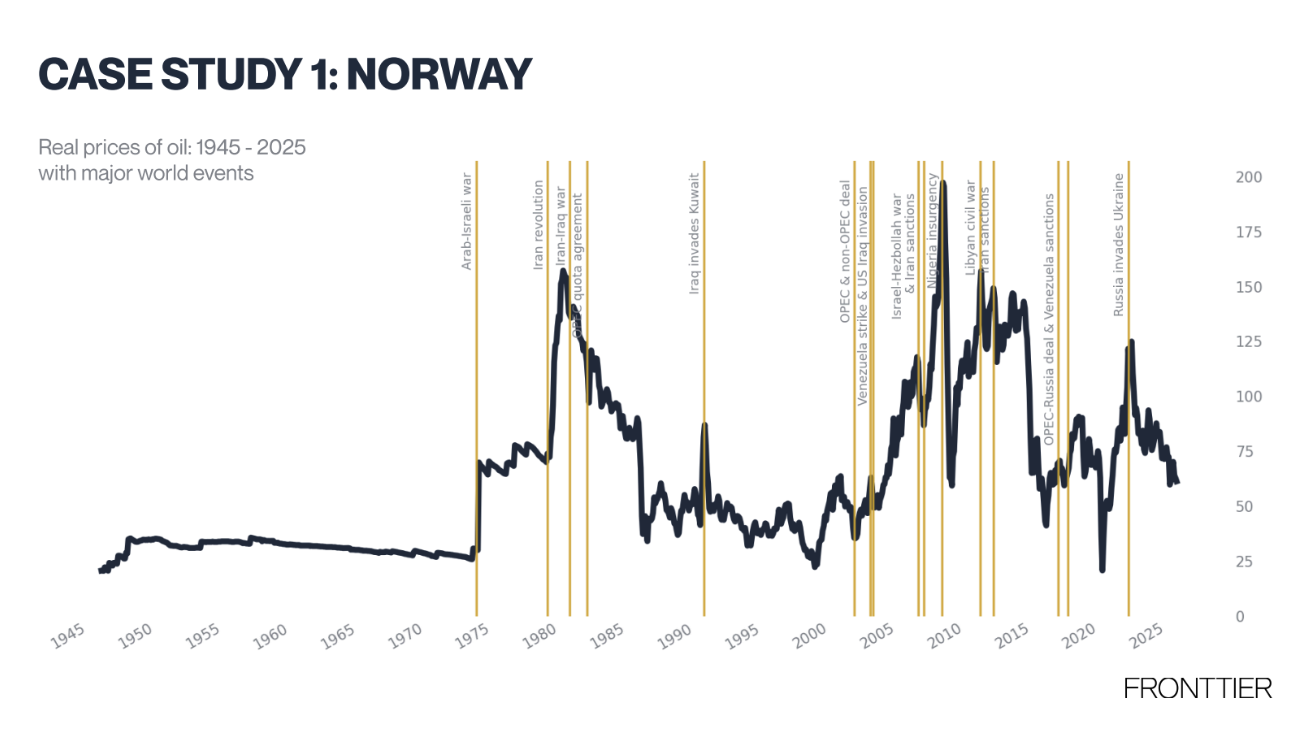
When we look at historical oil price data adjusted for inflation, the truth is stark. Every time oil prices have spiked, it’s been because a major oil-producing country has fallen into chaos: war, revolution, sanctions or a combination of these. Conversely, oil prices have crashed when all producing countries were able to pump freely without interruption
The conclusion is nasty. Norway has built its oil industry—and with it a $2tn fund and one of the most generous welfare systems in the world—because of war, collapse or sanctions elsewhere. When another country becomes autocratic, faces sanctions or is shut out of the global economy, Norwegian oil becomes more valuable
The sad reality is that Norway’s wealth and high standard of living have been made possible by the poverty, misery and conflict in other parts of the world
Norway, a global symbol of democracy, freedom and peace, paradoxically benefits economically from autocracy, the lack of freedom and conflict elsewhere
So Norwegians, try to understand why the world points at your incoherences and above all, please be humble
More posts about the topic
.png)