
Nasdaq as the world's liquidity drain
Jun 11, 2026
It's a shame business schools don't teach plumbing
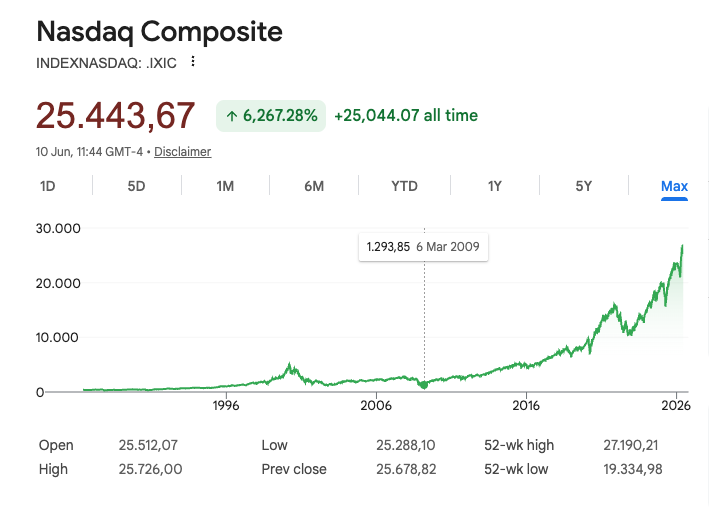
Every time I look at the Nasdaq Composite chart, I get a bit of vertigo
Since its post-financial crisis low in March 2009, the index has climbed from 1,268 points to more than 25,000. That's almost an 18-fold increase. By far, it has been the fastest-growing major stock index in the world over that period
To understand how extraordinary that is, compare it with other markets. Hungary's BUX came in second at 13.1x. Taiwan's TAIEX reached 10.2x, the S&P 500 10x, Oslo 9.4x, India's Nifty 8.9x, Japan's Nikkei 8.3x, and the Dow Jones 7.7x. Then the gap becomes enormous: Germany's DAX sits at 6.3x, while most European and Asian markets are stuck between 2-5 times
Now comes the uncomfortable part nobody likes to mention while celebrating record highs: the US economy has not grown by 1,800% since 2009. Tech companies haven't multiplied their sales by 18 either
What we have actually lived through is the largest monetary stimulus experiment in history
To repair the damage of 2008, central banks (the Fed, the ECB, the Bank of Japan, the Bank of England...) turned on all the taps at once. They cut interest rates to zero (and even into negative territory), printed massive amounts of money, and flooded the system with liquidity through consecutive QE programs in 2009, 2015, 2019, and the brutal "bazooka" during the 2020 pandemic
Simply put, they lubricated the money pipes like never before
The funny thing—or the scary thing—about the financial system is that it barely matters where the money starts. Eventually, much of it ends up in the same place: big tech stocks, mostly on the Nasdaq
Imagine the global financial system as one of those 90s showers with 20 water jets blasting from every direction. It doesn't matter which jet you turn on. In the end, all the water goes down the same drain
In today's markets, that drain is called big tech
Why there? Because these companies had three superpowers that acted like magnets for cheap capital
- First, absurd scalability. Once the product exists, serving one more customer costs almost nothing
- Second, immediate global reach. The internet lets them sell to the entire world without building factories everywhere
- Third, natural monopolies. Network effects and high barriers to entry allow dominant players to defend market share and profitability
The result is logical. When money is cheap and abundant, investors don't rush into a traditional screw factory. They allocate capital where growth is fastest, margins are highest, and liquidity is deepest
It's not magic. It's plumbing
The problem is that the environment has changed. The taps are mostly closed, and those same companies are losing some of their superpowers
- They are no longer as scalable: AI infrastructure requires enormous capital expenditure
- They are no longer as global: geopolitics is pushing countries toward technological sovereignty and local suppliers
- And margins are under pressure: energy, wages, and borrowing costs are all higher, while AI makes every query more expensive
The big collective mistake has been confusing an endless shower of liquidity with a permanent economic miracle
It's a shame business schools don't teach plumbing
More posts