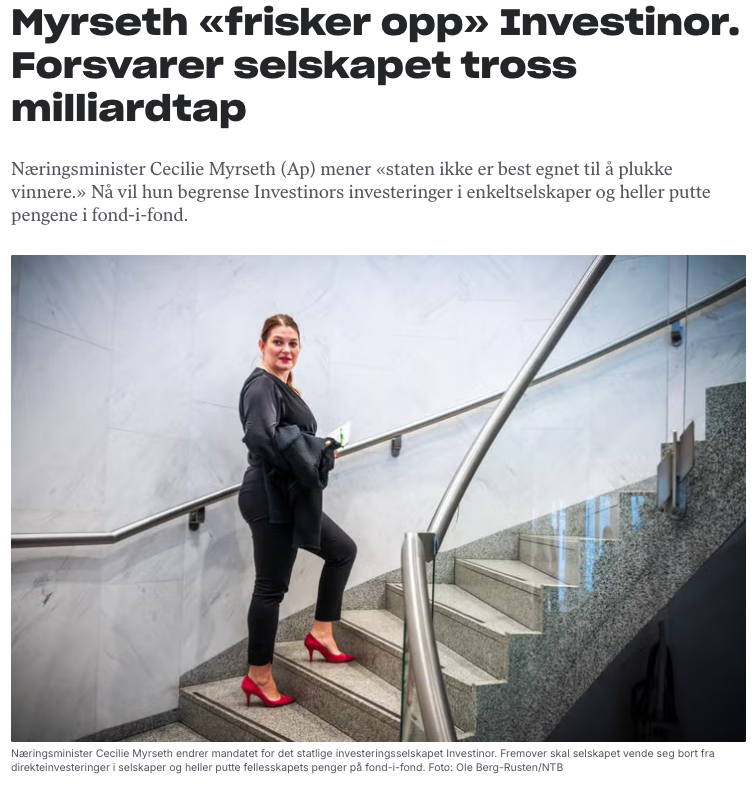

Open letter to Cecilie Myrseth
May 14, 2026
Investinor is not the problem. It is the tool that allows us to see the problem clearly.
Dear Minister,
In light of the results from the latest Investinor report, I understand the immediate political temptation to cut back what appears not to be flourishing, such as the direct investment mandate, in order to protect what looks better on paper
However making this decision based solely on surface-level figures would be a short-sighted reading of Norway’s industrial reality
When we observe that the 2013 direct investment fund offers a 5.6% return, or the 2018 fund barely 1.0%, we should not necessarily point to poor management by the investment team. Instead we must understand that these data are a faithful mirror of macroeconomic conditions and the nature of our companies
Norway is not Silicon Valley. We operate in a high-cost environment where the life expectancy of early-stage companies is lower and massive returns are the exception, not the rule. The fact that cumulative value creation in this segment is negative simply reflects that the local ecosystem has a natural ceiling on profitability that no manager, however skilled, can ignore under current market structures
On the other hand it is vital that you are not dazzled by the apparent success of indirect investments initiated in 2020. Although that mandate shows an attractive Internal Rate of Return (IRR) of 13.6%, we must be honest: IRR is a metric that rewards speed and theoretical valuations, but it does not guarantee cash in hand
The figure that should truly command your attention is the DPI (Distributed to Paid-In capital), which measures the capital actually returned. In that 2020 fund, the DPI is a mere 0.14, meaning that after five years, only 14% of the invested money has been recovered. We are looking at a "paper mirage" created by the excess liquidity of 2021 and 2022, when startup valuations were artificially inflated
Since then the market has reached an impasse and many funds are keeping those valuations frozen on their books because companies have yet to re-enter the market for revaluation in the current high-interest-rate environment. Declaring victory for the "fund of funds" model today is premature. Much of that 1.48 TVPI (Total Value to Paid-In) could evaporate if the market continues to adjust downward, as indicated by the current slump in transaction activity
I understand that following the Morrow bankruptcy, the Government has faced criticism and feels compelled to respond with changes. However closing Investinor’s direct investment arm is equivalent to breaking the thermometer because it shows a fever. Renouncing it means giving up strategic sovereignty at a time when other nations are equipping themselves to redefine and influence over their economic fabric
Investinor is not the problem. It is the tool that allows us to see the problem clearly. If the results are not as expected, the solution is not to discard the tool, but to review the objectives and limitations imposed or to adapt policies to the harsh real-world conditions of our industrial market
More posts about the topic